The reasoning behind Moon, manas and gemstone advice
A person is blamed for something they did not do.
At first, the problem is outside them. Then it begins to enter the mind. They keep replaying the accusation. Their emotions swing. Anger rises quickly. Decisions become harder. Sleep and concentration may suffer.
An astrologer watching this pattern may turn to the Moon and suggest Pearl.
Why the Moon?
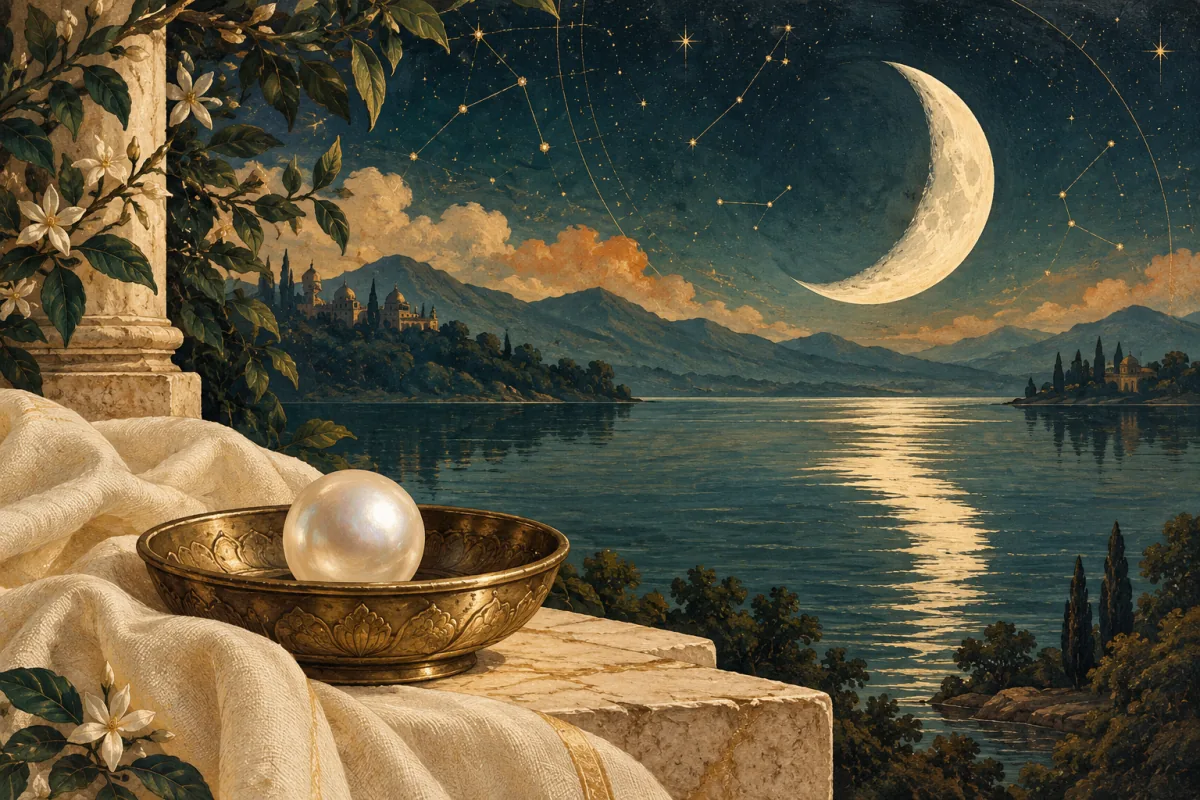
The important clue is not the accusation itself. It is the disturbance that follows. In Jyotish, the Moon is associated with manas: the part of us that receives impressions, responds emotionally and searches for safety. Pearl is the traditional gemstone associated with the Moon.
That is the logic behind the suggestion. The astrologer sees a lunar function under pressure and considers a lunar gemstone.
The logic is useful. The prescription still needs a horoscope.
The situation and the disturbed function are different
Astrology becomes vague when every unpleasant event is assigned directly to a planet.
Being blamed is an event. The response can involve several functions. Mars may appear through anger and confrontation. Mercury may appear through arguments, explanations and repetitive analysis. Saturn may appear through fear, isolation or the weight of public judgement.
The Moon enters the discussion when the experience unsettles emotional balance. The person is no longer simply dealing with an accusation. They are struggling to remain calm, steady and internally secure.
This distinction explains the Short that prompted this article. It was not saying that every accusation is a Moon problem. It was observing that unfair blame can disturb the mind so deeply that a Moon remedy may be considered.
That is also why two people facing the same event may receive different advice. One becomes angry and combative. Another becomes frightened and withdrawn. A third becomes obsessed with proving every detail. The event is similar, but the function under pressure is not.
Why Jyotish connects the Moon with the mind
The Moon describes our capacity to receive experience and feel its effect.
It is commonly examined for:
- emotional response and sensitivity
- the need for safety, familiarity and care
- memory and the repetition of impressions
- changes in mood and mental rhythm
- how quickly an experience settles, or refuses to settle
This does not mean that every difficult emotion is caused by the Moon. Human distress has real psychological, social and medical causes. Astrology can offer a symbolic framework, but it cannot diagnose anxiety, depression, trauma or any other condition.
Within Jyotish, the Moon becomes relevant when the question is about how an event is being held in the mind. A stable Moon is traditionally associated with the ability to feel without being carried away by every feeling. A pressured Moon may be read as greater reactivity, insecurity or difficulty returning to equilibrium.
The Moon is therefore treated as a natural significator of manas. Its rashi, bhava, nakshatra, associations and dasha help the astrologer understand how that lunar function is placed and when it may be more active.
This is interpretive language, not a clinical judgement.
Why Pearl enters the discussion
The Navaratna tradition assigns one principal gemstone to each of the nine grahas. Natural Pearl, or muktāphala, is assigned to Chandra, the Moon. The same traditional list associates Ruby with the Sun, Red Coral with Mars, Emerald with Mercury, Yellow Sapphire with Jupiter, Diamond with Venus, Blue Sapphire with Saturn, Hessonite with Rahu and Cat’s Eye with Ketu.
The Moon and Pearl pairing is therefore not invented from the colour of the stone or from a modern wellness trend. It belongs to a long Indian gemstone tradition. The traditional nine-gem correspondence records natural Pearl for the Moon.
Astrologers generally describe a gemstone as strengthening or supporting the planet it represents. That is why Pearl may be suggested when lunar qualities appear weak or disturbed.
This is also the reason casual gemstone advice can become a problem. Strengthening a planet is not the same as selecting one pleasant quality from that planet. The entire planetary role in the horoscope must be considered.
The same reasoning is used for other planets
The Short offers a useful way to understand how an astrologer moves from an observed difficulty to a planetary question.
| Area under pressure | Planet commonly examined | Traditional gemstone |
|---|---|---|
| confidence, authority, vitality | Sun | Ruby |
| emotional steadiness, receptivity | Moon | Pearl |
| courage, assertion, controlled action | Mars | Red Coral |
| speech, learning, analysis, decisions | Mercury | Emerald |
| judgement, guidance, faith, expansion | Jupiter | Yellow Sapphire |
| relationships, pleasure, art, harmony | Venus | Diamond or White Sapphire |
| patience, duty, endurance, limitation | Saturn | Blue Sapphire |
This table is a map of traditional correspondences. It is not a prescription chart.
Fear does not automatically mean Pearl. Anger does not automatically mean Red Coral. Low confidence does not automatically mean Ruby. The symptom points to a planet worth examining. The horoscope decides whether strengthening that planet makes sense.
The chart check that a short video cannot show
Before recommending Pearl, an astrologer should ask several questions.
1. What does the Moon own for this ascendant?
The Moon always rules Cancer, but Cancer falls in a different house for each ascendant. That house ownership gives the Moon a different functional responsibility in every chart.
For a Gemini ascendant, Cancer is the second house. The Moon becomes the second lord. For a Capricorn ascendant, Cancer is the seventh house. The Moon becomes the seventh lord. Both the second and seventh belong to the classical māraka framework.
That does not mean the Moon is “bad,” and it does not turn a Pearl into a prediction of harm. It means the astrologer cannot assume that strengthening the Moon is automatically favourable. Our article on the 2nd and 7th across all twelve ascendants explains why the same planet carries a different role in a different horoscope.
2. What is the Moon’s condition?
The astrologer should examine sign dignity, house placement, conjunctions, aspects and the wider chart. A Moon under pressure may need support, but the type of support cannot be selected from one symptom.
The same planet can carry both helpful and difficult responsibilities. Natural beneficence and functional role are separate questions. Why a good planet can give difficult results gives the broader house-lordship logic.
3. Is the Moon active now?
A present difficulty may be connected with the operating Mahadasha, Antardasha or a relevant transit. If the Moon is not central to the current period, the emotional disturbance may be part of another planetary story or simply a human response to a difficult situation.
Timing matters because a remedy should answer the chart that is active, not a generic list of symptoms.
4. What result is the person actually seeking?
“I want peace” is understandable, but it is too broad for a considered astrological recommendation.
Does the person need help managing a temporary conflict? Are they struggling with sleep after a stressful event? Are they seeking confidence to face an accusation? Is the real issue anger, fear, repetitive thinking or social humiliation?
Clear questions prevent one gemstone from being asked to solve several unrelated problems.
Why the māraka question matters, without creating fear
One of the most useful questions beneath the original video was whether Pearl should still be worn if the Moon has a māraka role.
That question is better than asking whether Pearl is “lucky.”
In classical astrology, the lords of the second and seventh houses enter the māraka calculation because of their relationship to the longevity houses. The term is technical. It does not mean that every period of such a planet causes death, and it should never be used to frighten someone.
For gemstone judgement, the practical point is simpler. A planet’s natural quality does not erase its house responsibility. The Moon may be gentle by nature and still carry a demanding functional role in a particular horoscope.
This is why chart-based advice is safer than sign-based advice. “You feel emotional, so wear Pearl” skips the part that tells us what the Moon is responsible for in that chart.
A responsible way to move from symptom to gemstone
The following sequence keeps the reasoning clear:
- Name the actual difficulty. Separate the event from the response it is creating.
- Identify the planetary function involved. Emotional instability may lead the astrologer to examine the Moon, while anger, speech or fear may point elsewhere.
- Judge the planet for the ascendant. Check house ownership and functional role before calling the planet favourable.
- Examine condition and associations. Dignity, placement, conjunctions and aspects can change how the planet operates.
- Check the current period. Mahadasha, Antardasha and transits show whether the planet is relevant now.
- Decide whether a gemstone is appropriate. The answer may be Pearl, a different traditional practice, a practical behavioural response or no astrological remedy at all.
This sequence does not reject the traditional remedy. It gives the remedy a reason.
A quick checklist before buying a Pearl
- Was the Moon examined for your actual ascendant?
- Were both of the Moon’s functional responsibilities explained clearly?
- Were its placement, dignity, aspects and conjunctions considered?
- Is a Moon-related dasha or transit relevant to the present problem?
- Was the recommendation based on your chart rather than one symptom or Moon sign?
- Were non-gemstone options and the limits of astrology discussed?
If these questions were not addressed, the reading may have moved from symptom to remedy too quickly.
What the Short gets right
Short-form astrology often lists remedies without explaining how the astrologer reached them. This video did something more useful. It connected an observed state with a planetary function.
The line of thought is:
Unfair blame disturbs the person emotionally. Emotional steadiness is examined through the Moon. Pearl is the Moon’s traditional gemstone.
That is a coherent astrological argument.
The missing part is the individual horoscope. A one-minute video can show the direction of enquiry. It cannot establish that Pearl is suitable for every viewer who recognises the symptom.
You can watch the original explanation here: Which Gemstone Will Bring You Great Fortune, Rahul Kaushik.
Frequently asked questions
Does feeling anxious or emotional mean I should wear Pearl?
No. Those feelings may lead an astrologer to examine the Moon, but they do not establish that Pearl is suitable. The whole horoscope and the person’s real circumstances still matter.
Can Pearl be worn if the Moon is a māraka lord?
There is no responsible universal answer. The technical role needs to be understood alongside placement, associations, strength and dasha. A māraka label should prompt careful judgement, not fear.
Is Pearl a treatment for anxiety or another mental-health condition?
No. Pearl is a traditional astrological gemstone, not a medical or psychological treatment. Persistent or severe distress needs qualified professional care.
Why not recommend Pearl from the Moon sign alone?
The Moon sign describes one part of the horoscope. House ownership and functional role come from the ascendant, while placement, aspects, conjunctions and timing add the rest of the context.
Astrology should not replace mental-health care
Emotional instability, persistent fear, severe anger, sleeplessness or an inability to function may require professional assessment and support. A gemstone should never replace appropriate mental-health or medical care.
Astrology can help someone reflect on patterns, language and timing. It should not turn distress into a planetary label or delay real help.
Conclusion: the question to ask before wearing Pearl
Do not stop at: Does this symptom sound lunar?
Ask:
What role does the Moon perform in my horoscope, and would strengthening that entire role support the outcome I need?
That question preserves the main insight from the video while giving the chart the final word.
See the Moon in your own horoscope
KPVichar can help you identify your ascendant, Moon placement and current planetary periods. Use the chart as the beginning of a careful discussion, not as an automatic gemstone prescription.
About the author
I write about classical Jyotish and astrology as a student, not as someone claiming the final word. While learning from source texts and teachers including Jyotish Vedang, I try to separate a useful general principle from a chart-specific judgement. If a stronger source corrects an older interpretation, the interpretation should change.
Disclaimer: This article explains a traditional astrological framework for educational purposes. Gemstone effects are matters of belief and astrological practice, not established medical treatment. Do not use astrology or gemstones as a substitute for qualified medical or psychological care.